

With a 37-year tradition, CECIIS is the largest scientific conference in the field of information and intelligent systems in this part of Europe. This year’s edition focuses on the relationship between people and digital technology, particularly the role of artificial intelligence as a cognitive partner in research, learning, creativity and complex problem-solving.
Among the conference highlights are keynote lectures by internationally renowned experts Professor Detlef Zühlke and Professor Jordi Linares-Pellicer, exploring the future of industry and the relationship between human and artificial intelligence.
Professor Detlef Zühlke, a pioneer of the Industry 4.0 concept and long-standing head of research into innovative factory systems at the German Research Center for Artificial Intelligence (DFKI), examines the evolution of smart manufacturing in his lecture “20 Years Smartfactory – From Smart Devices to Smart Ecosystems”: from connecting individual devices to establishing global data ecosystems. He pays particular attention to turning industrial data into value, the importance of shared standards, and the challenges of cross-border data exchange in the current geopolitical context.
Professor Jordi Linares-Pellicer of the Polytechnic University of Valencia, head of the VertexLit research group at the VRAIN institute and Academic Director of ValgrAI, challenges established understandings of intelligence and creativity in his lecture “Alternative Intelligence, Alternative Creativity: Rethinking What Intelligent Systems Really Are”. By comparing human and artificial neural networks, he explores the potential of systems that learn from experience, their capabilities and limitations, and the societal implications of the rapid development of artificial intelligence. He also emphasises the importance of AI literacy in making informed decisions about a technology that is transforming almost every area of human activity.
The Dean of FOI, Professor Marina Klačmer Čalopa, PhD, highlighted the conference’s long-standing contribution to scientific excellence and the Faculty’s international visibility.
“Thirty-seven years of CECIIS reflect FOI’s commitment to scientific excellence, international cooperation, and research that addresses the needs of society and the economy. More than 80 accepted scientific papers demonstrate the trust authors place in us, as well as the breadth of issues our scientific community explores. We are particularly pleased to welcome students and early-career researchers alongside established scholars, providing them with opportunities to present their ideas, engage in discussion and establish their first international collaborations,” said Dean Klačmer Čalopa.
This year’s programme features accepted papers by more than 200 authors from 19 countries, organised into thematic sessions covering intelligent systems, computer games, cyber-physical systems and intelligent energy, databases and knowledge bases, digital transformation and corporate culture, innovation and entrepreneurship, learning analytics and artificial intelligence in education, strategic decision-making, and software engineering.
The Chair of the CECIIS Programme Committee, Professor Nina Begičević Ređep, PhD, emphasised that the conference continues to evolve alongside the fields it explores.
“As intelligent systems evolve, so do the questions we ask as a scientific community and the ways in which we exchange knowledge. Following an international peer-review process, 76 scientific papers by more than 200 authors from 19 countries were accepted for this year’s conference. It is also particularly important to highlight that most editions of the conference proceedings published since 2013 have been indexed in the Web of Science (WoS), which is highly significant for the academic advancement of both Croatian and international researchers. This year, we introduced a pre-conference day for the first time, enriching it with new formats such as interactive workshops, panel discussions and networking sessions, which provide further opportunities for participants to exchange knowledge and experience and build connections. Alongside presenting scientific results, we want the conference to be a place where new research ideas, partnerships and projects take shape,” said Professor Begičević Ređep, Chair of the CECIIS Programme Committee.
The pre-conference day, held on 15 September, included the research workshop “Using Learning Analytics to Explore Learning Patterns and Paths” and the workshop “Agility in Action: Decision-Making for Today’s Higher Education”. Results and progress of the Regional Centre for Pre-incubation in Smart Industry project, implemented by the University of Zagreb Faculty of Organization and Informatics together with local partners, were also presented at Villa Oršić. The new Warm-up Talks format offered participants an opportunity to discuss current technological, scientific and educational issues in an informal setting.
The conference programme also includes expert talks by sponsors, as well as the Cracker Barrel and Project Oasis and Pitches formats, offering further opportunities for discussion, project presentations and connections between researchers and potential collaborators.
An important part of CECIIS is its international student section, which this year welcomes students from South Africa, India, Ireland, Slovakia and Croatia. By presenting their work and taking part in discussions, students gain experience in scientific communication and connect with peers and researchers from different academic backgrounds.
At the opening ceremony, participants were welcomed by Professor Jurica Pavičić, PhD, Vice-Rector for International and Interinstitutional Cooperation at the University of Zagreb; Neven Bosilj, PhD, Mayor of Varaždin; and Robert Kelemen, Director of the Public Institution European Talent Centre Croatia – Centres of Excellence of Varaždin County, representing the Prefect of Varaždin County. The ceremony was also attended by deans and vice-deans of Croatian and international faculties, representatives of the scientific and business communities, FOI scientists, researchers, teaching staff and students, as well as members of the CECIIS 2026 Programme Committee and the CECIIS 2026 Organising Committee, led by Assistant Professor Bogdan Okreša Đurić, PhD.
Through its three-day programme, CECIIS continues to connect the scientific and professional communities and encourage interdisciplinary cooperation in the development of intelligent systems. This year’s theme also raises a broader question: how can we guide their development to support human knowledge, creativity and responsible decision-making?
Awards and CECIIS 2027 theme
The Best Paper Award went to Kolok Peter of the University of Žilina Department of Technical Cybernetics for the paper "Correlation-Based Reduction of Environmental Input Variables for Efficient GRU-Based Prediction in IoT Systems". The Best PhD Paper Award went to Anamarija Mladinić for the paper "Designing Olivia AI: User Expectations for a Trustworthy GDPR Compliance Assistant". Asst. Prof. Dino Vlahek, PhD received an award for reviewing the most papers and student abstracts, in recognition of his valuable contribution to the conference's review process. Congratulations!
The closing event was also a chance to share final impressions and to look ahead: the theme of the next conference will be "Intelligent Systems for Human-AI Collaboration".
Thank you to all speakers, session chairs, reviewers, participants and partners who made this edition so rich and inspiring.
Acknowledgements
The successful organization of the 37th Central European Conference on Information and Intelligent Systems – CECIIS 2026 would not have been possible without the valuable support of our sponsors and supporters. We extend our sincere gratitude to all organizations, institutions, cities, counties, and companies that recognized the importance of the conference and contributed to its preparation and realization.
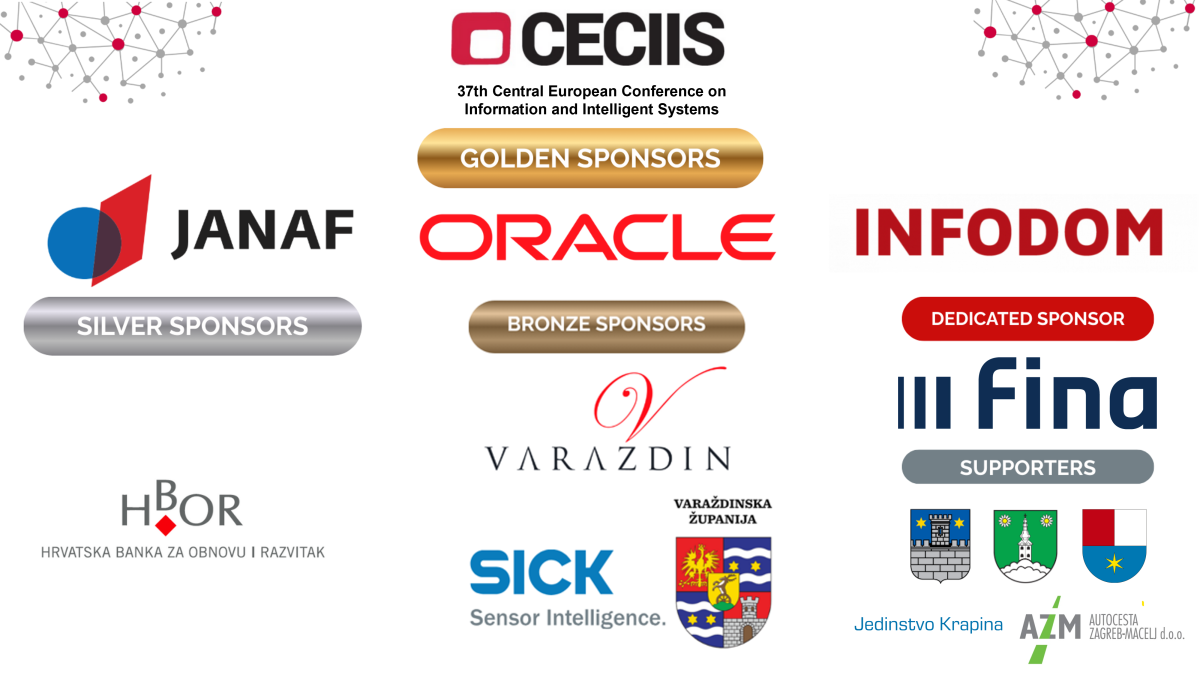
We are especially grateful to our sponsors and supporters: Gold Sponsors – Jadranski naftovod d.d. (JANAF), Oracle Hrvatska d.o.o., and InfoDom d.o.o.; Silver Sponsor – HBOR d.d.; Bronze Sponsors – City of Varaždin, Varaždin County, and SICK Mobilsis d.o.o.; Dedicated Sponsor – Financial Agency (FINA).
We also thank our Supporters: the City of Novi Marof, Autocesta Zagreb–Macelj d.o.o., the City of Čakovec, Međimurje County, Jedinstvo Krapina d.o.o., Pilana Ratković, and the Municipality of Gornji Kneginec.
Their support contributed not only to the successful organization of CECIIS 2026, but also to creating an inspiring environment that brings together researchers, academics, professionals, students, and representatives of the business and public sectors to exchange knowledge, ideas, and experiences in the field of information and intelligent systems.
We deeply appreciate their trust, support, and contribution to the CECIIS community and look forward to continuing these valuable partnerships in the future.
Thank you for being part of CECIIS 2026.
We look forward to welcoming you back in Varaždin next year!
Preconference day

Day 1.

Day 2.

Day 3.